To the parents reading this we are so deeply sorry that you are here.
We know the weight of the hope you carry, and the devastation of the medical results you never expected to receive. Please know you are not alone.
This is the story of our beautiful daughter, Sadhbh (pronounced 'Sive')—how she came into the world, how she left it, and the gratitude and grief we carry now.
After five years of trying for our third child and two miscarriages, we were pregnant again. We were more cautious this time, but absolutely over the moon. Two early reassurance scans showed everything was as it should be. The dates were a week out, but that had happened with our boys, so we didn't worry. After a smooth 12-week scan, we shared the news with family and friends. Physically, I felt good—tired, but not exhausted. The excitement in our house was palpable; our boys, then 10 and 7, were thrilled with the news.
At our 20-week scan, everything seemed fine at first. The room was filled with a happy buzz. The sonographer made small talk, asking about our family; we told her we had two boys at home, we talked about their ages and the soon to be age gap. She later asked if we wanted to know the gender. It was a girl! We were beaming; both so delighted. The sonographer commented that this little girl would be so adored and doted on by her big brothers. We agreed, she would be. We left that room and at that point we believed everything to be fine. We were sitting in the waiting room on cloud 9 waiting for our green notes to be returned before we could leave. Stephen looked at me — I will never forget it — he said I couldn't wipe the smile from my face, and I couldn't. I had just received the best news.
A few minutes passed, and the sonographer stepped back into the waiting room. She beckoned me back inside, then paused and asked Stephen to come too. My heart sank. I knew something was wrong. She explained that when they transferred the measurements to a second computer, it flagged that our girl was measuring small. We were being referred to the Fetal Medicine unit—a specialist team in Belfast—for an in-depth scan. They would call us in the next few days. I sat down, totally devastated. We left the hospital with no real information, so we chose to tell no one. Stephen was certain everything would be fine; whatever it was, we would get it sorted.
The next day, Fetal Medicine called. Our scan was booked for the following week.
When we arrived, the waiting room was packed. We reassured ourselves: Okay, this is busy, these anomalies must be common. Whatever it is can be monitored or fixed. We are in the right place.
Inside the scan room, four people waited for us—the consultant, midwives, and nurses, I think. They all had warm, kind faces. The consultant began the scan. It took a long time, but we chatted throughout. The atmosphere felt calm and relaxed, and we clung to the hope that the issue was minor. When she finished, the consultant asked us to take a seat. She told us there was an anomaly, but without further tests they wouldn't know what exact condition our baby had. She talked through various options. She mentioned that we would likely be eligible for a termination for medical reasons. We were completely floored — I couldn't speak or verbalise much at all. She explained that she could propose a termination for medical reasons to a medical council, and it would need to be seconded by another consultant, though she expected no contest. The other options were a private blood test or an amniocentesis. She explained that the blood test which she referred to as NIPT (Non-Invasive Prenatal Testing) would screen for chromosome abnormalities, it was a screening test, not a definitive diagnostic test. It would calculate the statistical probability or risk level of an anomaly – this test is routinely offered at 12 weeks in England, Scotland, and Wales, but not in Northern Ireland. An amniocentesis would be definitive, it would identify if our baby had a chromosomal abnormality such as Downs, Edwards or Patau syndrome, or other inherited genetic disorders, or potential infections. We knew a little about Down's syndrome, but we had no idea what the other two conditions were. We were told that because the blood test wasn't definitive, a positive result would lead to an amniocentesis anyway. We were both deeply distressed. We wanted to know how best to help her, so we decided to go ahead with the amniocentesis that afternoon.
Afterward, they took both our bloods to check for infections or hereditary conditions.
We left the hospital late that evening, shadows of ourselves, emotionally and physically exhausted. We had driven to Belfast in separate cars, which meant we now faced a two-hour journey home alone, with millions of questions and zero answers. Driving down the motorway, tears streamed down my face, grieving the healthy baby and the future we had imagined up until that point.
We were told the results would take 7 to 10 days, with a follow-up appointment booked in for two weeks’ time. The wait was awful. We had endless "what-if" conversations: What could it be? What would the treatment options be? Would we have to travel? Could we afford it? Would we need to sell or modify our home? How would we tell our boys?
I researched the conditions mentioned. To be honest, at that point I was hoping for Down's syndrome. I knew people with Down's syndrome who lived happy lives. I didn't know anyone with the other two conditions mentioned. They were so severe.
The following Wednesday, my phone rang. It was our consultant. She told me the results showed markers for Edwards' syndrome also known as Trisomy 18. She explained that it was a rare genetic condition caused by an extra chromosome. That most babies with full Edwards' syndrome die before or shortly after birth. It severely disrupts development, and 90% of these babies have congenital heart defects. The condition, she said, was not compatible with life. I couldn't speak. The tears just kept falling. Then she told me it was a random event. It wasn’t genetic. Random. She laid out our only two paths: a termination of the pregnancy for medical reasons, ending the pregnancy early to protect my physical and mental health or perinatal palliative care which would mean continuing the pregnancy with regular scans to monitor growth with the medical focus entirely on comfort care. She told me how sorry she was, that she herself hadn’t expected this result and asked us to talk and decide how to proceed. It was the hardest phone call of my life. I called Stephen, my voice barely audible, and he came home.
It’s been nearly a year since that phone call, and I still can’t believe it. We weren’t going to be able to keep her.
A week passed. We didn’t call the hospital; instead, we went to the pre-scheduled appointment. We had made our choice. We wanted to continue. We wanted to give her every chance – I had read that palliative care didn’t mean death, it also means living as well as possible with a serious illness. The consultant set our support system in motion, referring us to fetal cardiology, genetics, neonatology, palliative care, and a bereavement midwife. Our GP and our local hospital in the Western Trust were also notified so local palliative care could be arranged so we could bring her home.
From then on, we were scanned regularly. On 23rd December, we met the cardiologist. He confirmed our girl had a large ventricular septal defect, with her aorta pushed to the right—likely a double outlet right ventricle. He told us that if she didn’t have Edwards' syndrome, this heart condition could have been corrected with surgery in Dublin. But given her diagnosis, she would not be eligible for surgery. He told us her heart wouldn’t be an immediate issue when she was born, that if she was born, she would likely become breathless over time. He said the situation could be reassessed after birth.
We spoke to a genetic consultant, who helped us understand her condition, how it would impact her. She explained to us that typically people are supposed to have 46 chromosomes in total, arranged in 23 pairs, we inherit one from our mother and one from our father for each pair. Edwards Syndrome happens when there is an error in how the cells divide. Instead of a pair, Sadhbh developed three copies of chromosome 18 instead of the usual two. A glitch in the cellular copying process. A glitch. Because chromosomes are the instruction manual for the entire body, having a whole extra set of instructions for chromosome 18 was disrupting how she would develop, affecting multiple parts of her development at once. They told us because we were already having a baby with Edwards syndrome, the risk of it happening again in a future pregnancy would be higher than the risk for the general population.
We searched the internet, trying to learn what we could about Edwards' syndrome. I read every family story on the SOFT UK website, looking for help, direction, other options.
Every medical appointment was hard. There was never any good news. The information was always frank and worst case scenario, never offering an ounce of hope. We were incredibly fragile and very scared. You hear a massive amount of information, it is hard to process and take in. Things said in appointments were written in letters afterwards that didn’t convey the same meaning. When we asked questions, we were met with answers like, "only time will tell," or "we just don't know."
We both continued to work, I hadn’t shared her diagnosis with colleagues, I needed work to be a distraction, to be safe, free from devastation. I didn’t want people to change their behaviour around me, I was delighted to be pregnant with her, colleagues were happy for us and I needed that positivity to continue, to carry me through. We began telling our family and close circle of friends. It is such hard news to give. People were devastated for us, but there was nothing they could do, nothing they could say, and no way to fix it. It is a heavy road to walk, and it does feel incredibly lonely.
Meanwhile, our baby girl was still kicking away, mostly active at night. She felt strong. We learned that around 70% of pregnancies diagnosed with Edwards' syndrome end in miscarriage or stillbirth. However, we knew that the percentage decreases as the pregnancy progresses. We lived in hope that the longer the pregnancy lasted, the greater the chance she would be born alive.
Christmas came and went—all a bit of a blur. We hadn't told our boys yet, so we carried on as normal.
While the specialist care for Sadhbh took place in Belfast, my routine care remained with our local hospital within the Western Trust. There was no continuity to my care; I didn’t see the same consultant twice. Although every individual consultant and midwife was lovely, the system itself felt deeply flawed.
The first consultant performed our 12-week scan, and we never saw him again. We were called an hour late for our second appointment. That consultant explained she had been reading our notes to prepare, which felt fair—until she went on to tell us to prepare for a stillbirth. When we mentioned we had been referred to the local bereavement team, she informed us that the bereavement midwife for the trust was on leave. In truth, no one from our local bereavement team ever contacted us during this time. At this point, we didn’t even know where we were going to give birth. When we asked if the hospital had a dedicated bereavement room, we were told they did not; instead, a purple circle would simply be stuck to a standard labour room door to indicate a bereavement.
Our meeting with the third consultant was tough and confusing. It was evident during the scan that she hadn’t read our notes, and she looked visibly alarmed. Stephen had to begin explaining the diagnosis we had received. The consultant knew very little about Edwards' syndrome, telling us that our daughter "could be a fighter and survive." It wasn't until seven and a half months into the pregnancy that our digital notes were updated with a prominent red flag so the diagnosis was obvious to anyone opening the file.
Desperate for direction, we joined a SOFT UK virtual call for expecting parents. There, we met a mother from Northern Ireland who had also had a baby with Edwards' syndrome. She told me I should reach out to the Northern Ireland Children's Hospice, and a few weeks later, she called me privately. We spoke on the phone for nearly two hours. She shared her daughter, Amelia’s story and told me about babies who had survived much longer than expected.
For the first time, there was hope.
Hearing real-life stories from families who had walked this path changed everything. It wasn’t all doom and gloom. It was ok to be happy that I was pregnant, and to keep hoping. In the weeks that followed, we felt less alone.
I filled out a form on the Northern Ireland Children's Hospice website, and Vallerie called a few days later. She congratulated me on my pregnancy—and that simple gesture meant the world to me. I was pregnant, I was delighted to be, and I was thrilled to be having a girl. She was still growing, she was active, and her heart was beating strong. Inside me, she was safe. The woman asked if we had chosen a name. We had. I told her, her name is Sadhbh—an Irish name that means "sweet." After an hour-long chat, we booked an appointment for our family to visit the hospice in Belfast.
The evening before our visit, we sat down to tell our boys that their little sister was very ill. We explained that she might not be able to come home, and that we would need a lot of help and support from the hospice when she was born. It was very difficult. Our eldest, 10, was quiet; he is a thinker. Our youngest, 7, was deeply emotional and asked endless questions we didn’t have answers for—he wanted to know in certain terms exactly what was going to happen. That night we read them a book called “We had to say Goodbye before we even met” by Irene Teague, it’s a book written for children who have lost a sibling through pregnancy or early baby loss.
Around this time, we also started the boys in play therapy to help them navigate their feelings. Shine Play Therapy had such a profound, positive impact on them. Lisa provided a safe space where the boys could completely be themselves, allowing them to understand and process their grief without the fear of upsetting us. Over the course of nine months, Lisa’s impact on our family was profound. She didn't just support the boys individually; she brought us all together for an outdoor family session that has become a core memory we will carry forever. Thanks to her guidance, our boys talk about Sadhbh easily and carry her memory with them every single day. Before their sessions ended, Lisa gave the boys an oak tree, which they have since planted in our garden in memory of their sister.
Our visit to the hospice blew us away. The kindness and compassion in that building was overwhelming. It is not a place you would ever choose to be, but when it becomes your reality, you are filled with gratitude. We talked about potential options, once Sadhbh was born, we as a whole family would move into the hospice with the eventual goal of working towards getting home. Her medical needs would be assessed, and they would teach us how to care for her needs. They gave us the strength and much needed hope that caring for our girl at home wasn't impossible.
At the same time, we coordinated with Barbara, the bereavement midwife at the regional hospital in Belfast. A truly incredible woman and a real-life walking angel. She is a person that brings a rare grace, reverence, and fierce advocacy that protects the dignity and memories of grieving families. She is, in every sense, an invaluable pillar of compassionate healthcare. We will never forget her kindness, compassion and support.
As our pregnancy progressed, my scans were increased because the placenta was showing signs of weakening. At the beginning of March, we attended our final appointment in the fetal assessment unit. It was a day crowded with faces. We met with our fetal consultant, a bereavement midwife, a lactation consultant, a neonatal consultant, and a representative from the hospice. It was a completely confusing, overwhelming time. In one meeting, we were talking to a lactation specialist about expressing colostrum so we would have it ready when she arrived. In the very next, we were discussing wishes for potential end-of-life care, should that be what we were faced with imminently.
The neonatal appointment shocked us. I asked the consultant exactly what would happen in the moments after she was born. She explained that Sadhbh would stay with us—she would not be placed in an incubator, she would not be connected to any wires, and they would not intervene to prolong her life. While we had already accepted that she would not be eligible for major surgeries, this felt like new, crushing information. We were totally devastated. She had fought so hard and gotten this far, yet they would do nothing to prolong her life; they would do nothing to save her. Instead, they talked about the medical ethics of quality versus quantity. Looking back, I feel that confirming Edwards' syndrome through the amniocentesis changed the trajectory of the care we were offered, limiting our options to palliative care alone. We were never presented with a parallel approach of active medical management focused on survival. Instead, it was a "wait and see" approach—waiting to see how she did first. They told us they would not do anything to prolong her life. They would not intervene. I remember those conversations vividly, and they still shock me to my core.
During all those earlier hospital appointments, I don’t think we ever truly comprehended that we were the worst-case scenario in that waiting room. When you sit there, you look around at how many sick babies there are in the world and think, God help those poor parents. At the beginning, we hadn't realised that we were those parents. We didn't fully understand how desperately dire the situation was until that day. Still, with the help of the hospice representative, we began documenting our specific wishes for the birth and for afterwards, planning for every eventuality—things no parent ever wants to have to consider for their child.
The instinct to nest was still there—the urge to clean the house and get ready—but it was heavy with uncertainty. I wondered what to buy, what we would need, what would help, and if we would even get to use any of it at all. When it came to packing my hospital bag this time, I was at a loss. Should we bring a car seat, bottles etc how many outfits do we pack? In the end, the standard list didn't matter. We packed clothes, hats, a blanket, and a soft rabbit teddy bear that her big brothers had chosen for her.
Because the local Western Trust bereavement team had never reached out, we made the conscious choice to give birth at the regional hospital in Belfast. We needed to feel safe and supported. Looking back, I do wish the local bereavement team had reached out. If they had offered that level of support, that continuity of care, we likely would have given birth locally. Had we stayed close to home, more of our extended family would have had the chance to meet and hold Sadhbh when she was living.
Because my placenta was showing signs of weakening, we were booked in to give birth at 37 weeks + 5 days. Our medical team had strongly advised us against a c-section. I wanted to carry her for as long as I could safely, I wanted her to get stronger, but we were also conscious of the advice from the medical team and scared that waiting would end in a still birth. We didn’t challenge our medical team on the recommendation to avoid a c-section. In previous pregnancies I understood vaginal birth to be beneficial for a baby, and it also meant that I could go with Sadhbh to the hospice as soon as she was ready to be transported. What I have since learned is that there is a much higher probability of babies with Edward Syndrome dying in active labour. Studies conducted on survival indicates that a c-section would not have increased the long-term survival window but for us it could have meant more days with Sadhbh.
We barely slept the night before. Our bags were packed, and we set off for Belfast, not knowing when we would be home again, or if she would be coming home with us.
The months leading up to this moment had become a blur, a chaotic mix of total devastation, unrelenting fear, and hope all rolled into one. Sleeping had become impossible. In those final weeks, I would stay awake into the early hours of the morning because that was when she was most active. I would just lie there, watching my stomach move and feeling her kicks, silently willing her to fight.
When we arrived at the regional hospital, we were brought to the maternity ward. Much like our local hospital, there was no dedicated bereavement room here. Instead, they gave us a room at the very end of the hall. It had exits on both sides, which meant we could leave without having to walk past the other rooms, though we shared a toilet with another woman in labour.
Our first midwife, Hayley, immediately put us at ease. My waters were broken, and the induction process commenced. However, as the hours ticked by, labour failed to progress. Later that night, the medical team officially declared it a failed induction. Though the process had stalled, the care we received never wavered. Another midwife, Megan, took over for the evening shift, and the following morning, a midwife named Wendy stepped in. Throughout our stay, these three midwives rotated to care for us. All three were incredible, showing us a level of kindness and compassion that we will never, ever forget.
The consultants on the ward did their rounds the next morning to discuss our next steps. The consultant on staff recommended using a pessary to bring on labour. However, this plan was quickly retracted when our midwife stepped in and highlighted that the recommended method would terminate the pregnancy. We couldn't believe it. The goal was always to meet her alive. The team then recommended trying the induction process one more time; if that failed, we would proceed to a c-section. The second induction worked, and labour kicked off. The room felt calm, the contractions grew strong, and despite everything, we were excited to meet our girl. When the midwife checked me around 4pm, I was 5cm dilated. Just twenty minutes later, it was time. I had never been more terrified in my life. I couldn't even open my eyes; I just held onto Stephen. So afraid.
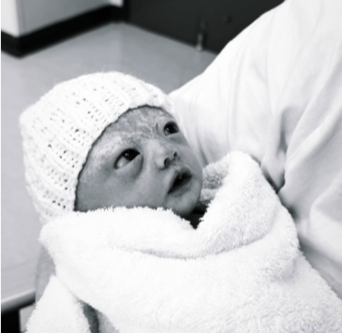
Sadhbh was born at 4:40pm. It was silent. There was no loud cry. Wendy placed her onto my chest and began gently rubbing her skin. I took big, deep breaths, waiting. We thought she was gone. Then, she started to move. She was alive. Pure relief washed over both of us. We were both crying. Wendy called the consultant to witness her living. Looking back this was our miracle. She was finally here. Ten fingers, ten toes. She looked exactly like her big brothers. There was no loud cry but she did start to make sounds—the most gorgeous little newborn sounds. They wrapped her warmly in a towel and gave her back to us. She seemed so alert. To my amazement, the entire experience felt just like the births I had had with our boys. I was induced with them too. I remember Stephen looking at her and saying he thought we could have her for a long time because she seemed so strong. We thought she was coming home.
The midwives weighed, measured, and dressed her. Soon after, her big brothers came to meet her, alongside my sister and my two nieces. Everything felt fine. There were no monitors, no beeping or alarms, no emergency. We had her baptised right there in the room. When we asked the priest to also give Sadhbh the last rites, even he looked confused—she looked fine. The midwife explained to him that she was ill.
We spent what would become the best evening of our lives where we had our three children all together.
The bereavement team brought us a memory box from a charity called 4Louis. Inside was a collection of keepsakes: a candle, two pink knitted love hearts, two white rabbit teddy bears, a butterfly keyring, a Christmas tree bauble, clay moulding, and hand and footprint sets. That evening, as Sadhbh lay peacefully in Stephen's arms, Megan gently helped us press her tiny feet and hands into ink, capturing all those beautiful little memories.
We took photos and videos, soaking in the way she looked at us and responded to our voices. I read her a book. I told her the story of how she came to be, how Stephen and I had met, and the lives we had lived before she got here. I sang her the very same lullaby I had sung to her big brothers when they were babies. There was so much joy in that room. At one point shortly after she was born, Stephen gently lifted her blanket to check on her. The cool air hit her, and she reacted instantly, making a little face and sound as if she were scolding her daddy for making her cold. We both laughed—a perfect, ordinary family moment that we were lucky enough to capture on video.
Stephen and I spent the night with her. We fed her and changed her; she was sleepy and content. It felt so normal, so similar to those first few hours with our boys. There was no palliative care team in the room. We would go to the hospice the next morning. Looking back, I hadn't fully realised that we were her palliative care team. For that one night, we lived in a perfect little dream, a protective bubble where we genuinely believed we had more time with her. All she ever knew was our love.
Shortly after 6:00am the following morning, her breathing changed. I knew in my heart she was leaving us. I pressed the call button, and Megan came in. She assured us there were still faint flutters of a heartbeat and she paged the neonatal team. The team were caught in an active emergency. By the time the consultant arrived after 8:00am, our sweet Sadhbh was gone. She died in our arms. I couldn’t understand it. She was perfect. She was just here. She was breathing. We were only getting to say hello. Even now it’s still hard to believe.
When a baby dies in the hospital, there is a lot of paperwork, different forms to sign, and decisions to make. I don't remember much of the rest of that day. But I do remember Hayley helping us to gently bathe and change her. She cut a beautiful lock of her hair for us—Sadhbh had a big, gorgeous head of brown hair.
I also remember our bereavement midwife, Barbara, and our fetal consultant, Gillian, coming to meet her and hold her. They treated us all with the utmost dignity. The compassion and care we received from that Belfast team in our darkest hours was incredible.
Before we could leave, I was given medication to suppress my milk supply. I was also sent home with a six-week course of Clexane injections to prevent blood clots.
When it was time to leave, Stephen carried Sadhbh out of the hospital, cradled gently in his arms inside a Moses basket. The staff asked if we wanted to leave through the main entrance, but we didn’t. Instead, the bereavement team quietly walked us out a different way and accompanied us all the way to our car. We had chosen to take her home ourselves, rather than having a funeral director collect her. We needed to be the ones to bring her home. We began the long drive home. This time, I sat in the back seat with our daughter resting on my lap. The hospital had given us an official letter explaining the situation, a necessity in case we were stopped by the police on our way home. Outside the car, people were just going about their ordinary days, completely unaware. It felt so strange.
We arrived home. The hospice had coordinated with our local Western Trust to have a cool cot delivered to our house. That evening, we met with our local priest and our funeral director to select a final resting place in the graveyard closest to our home. We spent the rest of the evening surrounded by our families, and a Mass of the Angels was arranged for the following afternoon.
This would be our only night at home as a family of five, so we lifted Sadhbh into our bed and kept her close. Early the next morning, we looked through a book of readings and reflections the funeral director had left behind, trying to find the words to say goodbye to our girl. My sister stepped in to organise almost everything else. Outside our window, we could hear the birds singing and the sheep baaing in the fields. We sat in bed for hours, holding her while the house downstairs quietly prepared for our final journey together. Her cheeks were still so soft. She was so lovely, with that big head of brown hair, a little button nose, pouty lips, and a perfect wee face. We just stared at her, soaking in every single detail.
Sadhbh was buried with the rabbit teddy bear the boys chose for her, alongside the storybook we read and a letter I wrote to her. From the keepsake box we were given, we also placed one of the pink knitted hearts and the silver heart insert from the keyring in with her. Now, the boys have the two white rabbits from her, while I carry the keyring and the matching pink knitted heart with me. I would never have thought of these things myself; the boxes are so carefully curated for grieving families and give us a precious sense of connection now.
After losing her, it felt as though the world had completely lost its colour. I realised then that I would never feel fully joyous again—that peak, pure joy I had felt when I had all three of my children together in that room. She would always be missing from me.
The first few weeks postpartum are supposed to be for the newborn bubble: the night feeds, explosive nappies, gorgeous outfits, milky smiles, and fat little leg rolls. Because she wasn't there, I found it too hard to stay at home alone during the day. The silence was too loud.
A local community midwife, Claudine came out to see me for the routine postnatal checks, and I was so grateful for her. She is incredibly kind and always has a gorgeous way about her. She is someone who can sit with you and hold the weight of your grief without trying to fix it.
Two weeks after Sadhbh died, the bereavement midwife from our local Western Trust contacted us for the very first time. She sent a text message. We had been waiting for four months for someone from that team to reach out. I never responded.
When it came time for my six-week postnatal check, I called my GP’s office. The receptionist who answered was someone I didn't know. She told me they didn't really do those appointments anymore. Without asking for my name, she asked if I felt okay. I didn’t know how I felt, but I told her I felt okay. That was it. I was signed off.
The following weeks passed in a blur, though we forced ourselves through the motions of daily life. Even simple choices—like what to do or what to have for dinner—felt overwhelming. When we noticed the boys showing similar behaviour, we mentioned it to Barbara, our Belfast Trust bereavement midwife who was still keeping in touch with us. She explained that they were likely modelling their behaviour after us, and we knew then that we had to try and move forward. We wanted to give them normality, consistency, and happiness, and we didn't want their memories of their baby sister to be our grief. We started walking, we would walk laps around our local GAA grounds. It was somewhere close to home where we felt safe—a place where you could just sit in the car if you weren't up to it or get out and watch football among people. You could talk if you wanted to or just walk if you had no words. Stephen even returned to playing football. The GAA slogan its “Where we all belong” has never felt truer to me than it does now.
In the weeks and months after Sadhbh’s death, we received hundreds of messages, cards and letters of condolences. People sent flowers, groceries, scones, people sent little keepsakes in memory of Sadhbh, personalised cards with her name on it, a teddy bear with her name and date of birth engraved on it. The support and compassion shown to us meant more to us than words can express – from friends, family, neighbours, people we didn't know personally. The support and compassion we received carried us; it gave us such a lift. Every time the post came, I would cry. It meant so much that people were thinking of us, thinking of our Sadhbh — that she would be remembered. People showed up for our family in ways we could never have imagined. Amidst the most horrendous event of our lives, the kindness and compassion of people shone through. We will never, ever forget it.
Yet, even with a village around us, the weight of the loss remains absolute. I was referred for bereavement and trauma counselling. My memory became fractured, and both Stephen and I found ourselves sensitive to loud noises. We were told that these were classic physical responses to trauma. Our brain and body changes when our world shatters.
It just over eight months since we lost her. Looking at the calendar, I realise that this time last year, we were driving to those early hospital appointments just before we received her diagnosis. I miss those appointments now, back then, it was such a happy time. We were just a normal, excited family, unaware of the storm ahead, carrying a beautiful little girl who changed our world forever.
I thought I knew what grief was until it became mine. Some people say to us, ‘I don’t know how you do it, I wouldn’t survive it.’ To be honest, we didn’t. The people we were before we had her didn’t survive. We still look the same—the change isn't wildly noticeable to others—but our outlook on the world has permanently shifted. We have a completely different perspective. Things that once felt like big deals just aren't anymore. She was born on a Tuesday and gone on Wednesday. How are those ever supposed to be normal days again?
Grief feels like a deep tiredness in your bones. It is like constantly treading water. Some days we feel like we can carry the weight of the world and manage well. A lot of the time, it’s a real fight to be ok, to be out, a mental battle with yourself. And some days we just stay at home. It is all so profoundly unfair—that she couldn’t stay, that she couldn't live her life beyond a single day, and that we had to say goodbye so soon. When I look at photos of us from before, we look so carefree. We had no idea what a broken heart really felt like—the physical pain, the sheer, crushing weight of it. I used to have a plan, a clear direction for my life, but I don't really look ahead anymore, not in that way. It’s difficult to plan, to look forward, or to feel real excitement. When you are still living and breathing after the unthinkable, and the mornings and evenings just keep coming anyway, you wonder how.
I listened to a podcast called ‘Dads Don’t Cry’, where a bereavement counsellor explained that while parents grieve the loss of the same child, the grieving process is completely unique to each person. He used the analogy of a rollercoaster: we are both on the exact same ride, but in different carriages. If I were in his carriage, I wouldn’t feel safe, and equally, if he were in mine, he wouldn’t either. This simple analogy helped us more than I can say. It helped us understand that it is entirely normal not to grieve the same way. This information while it seems obvious has helped us to understand each other’s grief and support each other better.
I would describe us both as high-functioning grievers, putting one foot in front of the other, putting on brave faces, and getting out into the world. We are so grateful for the people who have shown up for us this year: those who called, texted, visited, and sent cards, keepsakes, and food in the early days, as well as those who kept reaching out in the months after to ask us for a walk, breakfast, lunch, dinner, or a night away. It comes a little easier now, but in the beginning, we had to build ourselves up for these interactions. We would ready ourselves, put the mask on, and go—yet we always came home feeling a little lighter. I know now that it is not easy for others either. People often do not know what to say—I do not even know what to say myself—but the distraction helped. Sometimes there are no words that can adequately convey the grief someone is carrying, and no one can fix or change what has happened. Instead, the quiet support of those who showed up despite not knowing what to say carried us through. It gave us a distraction, and that in itself is a gift.
In the very early days after losing Sadhbh, we made a promise to each other to just keep going, whatever it took, we would not let the ship sink. And along the way, we learned how to parent in two directions at once—the two boys we can reach, and the girl we can only carry in our heart. We do things in her name now, and we call that parenting her, too. There is still an overwhelming need in me to be her mummy, a feeling I can’t fully explain. I find an outlet for it by visiting her grave, changing the flowers, attending remembrance services, hanging her pictures and art that reminds me of her on our walls, writing notes to myself. We speak about Sadhbh at home. In our house, she is never a heavy silence we tiptoe around; she is a core part of our family.
When my sister got married, Sadhbh was beautifully remembered during the service. Since then, her name has found its place on tributes across the country—on a star in the garden at the Northern Ireland Children's Hospice, in the Book of Remembrance at the Belfast Royal Hospital and engraved onto the White Butterfly Foundation’s tiled memorial wall to be shown in the Long Gallery at Stormont, her photo is held in the SOFT Northern Ireland Book of Remembrance. Soon, her name will also be placed at Croke Park through the Ár Réaltaí Beaga initiative, alongside other little stars gone too soon. The most special, was on my birthday, Stephen signed my card from him, Donnacha, Senan and Sadhbh, it was the best gift he could have given me.
These tributes matter deeply to us. They are the visible, lasting evidence of her life. Our wish is that she will always have a place, that she will always be remembered.
Its November now and the days are running out on 2026 and I know closing the door on this year will be difficult, the year we had her. Now, I worry about losing my memories of her. It’s not about the photographs; it’s about being able to sit quietly and still visualise holding her. I am afraid of forgetting her sounds, or the exact touch of her skin. I worry that as time carries me further away from her birth, those memories will begin to soften and fade as they do.
We grieve Sadhbh—the baby we had, and the daughter we will forever miss. The 17th of March, St. Patrick’s Day, will live in my heart forever as one of the greatest days of my life: the day she was born. We try now to focus on what we had, rather than what we have lost, knowing we got every single moment of her there was. Life is just different now. Joy isn’t quite as joyful as it used to be, and the colours of the world are not as bright. Yet, life still holds beautiful things, and we carry Sadhbh with us through it all. It was the absolute honour of my life to be her mother, and I am so incredibly proud of her. She was the measure of my dreams.
Our story doesn’t provide answers or give you solutions for a path forward, I can’t tell you how much I wish it did, but I hope it gives you some strength and hope to know you are not alone, there are dark days ahead but there is also light – keep reaching for it.
Sadhbh’s Mummy, Roisin